
SQLITE NOT INSTALLED
When it comes to creating vessels that brave the open seas, both shipbuilding and marine welding techniques play a crucial role. These two interwoven disciplines not only ensure the integrity and safety of ships but also dictate their durability, efficiency, and overall lifespan. Whether you’re an industry professional, a student, or simply a curious enthusiast, understanding the fundamentals and advancements in shipbuilding and marine welding can offer fascinating insights into the maritime world.
This extensive article dives deep into the history, processes, technologies, and innovations behind shipbuilding and marine welding techniques. We’ll explore how the craft evolved over the centuries, the modern materials and methods used, and why these skills remain vital in today’s maritime industries. Along the way, you’ll learn how welding is tailored to withstand the harsh marine environment, and how shipbuilders engineer vessels that sail safely and efficiently.
Understanding the Foundations: What Is Shipbuilding?

Shipbuilding is a complex industrial process that involves designing, constructing, and assembling ships and other floating vessels. At its core, shipbuilding combines art, engineering, metallurgy, and craftsmanship to create a functional and safe ship capable of navigating the world’s waterways.
The process includes the design phase, material selection, fabrication of modular components, assembly, and final outfitting. Each stage requires precise coordination between designers, engineers, fabricators, and welders. The end goal? To produce ships that meet the required performance standards and regulatory approvals.
Historically, shipbuilding dates back thousands of years, evolved from simple wooden boats to the massive steel carriers and naval vessels we see today. Modern shipyards employ cutting-edge technologies and rely heavily on advanced shipbuilding and marine welding techniques to build vessels that perform efficiently and endure tough marine conditions.
The Evolution of Shipbuilding Through the Ages
From ancient clay and wooden vessels to the steel giants of the 21st century, shipbuilding has been a constantly evolving craft shaped by necessity, innovation, and exploration.
- Ancient Shipbuilding: Early civilizations, including the Egyptians and Phoenicians, built wooden boats by hand, often using mortise and tenon joints and caulking to make hulls watertight.
- Medieval Period: The Viking longships showcased advanced design features like overlapping planks (clinker-built), allowing for more flexible and seaworthy vessels.
- Industrial Revolution: The transition to iron and then steel hulls dramatically changed ship construction methods, necessitating new assembly and joining techniques, such as riveting and later welding.
- Modern Shipbuilding: Today’s ships are constructed from high-strength steel and composites, using automated cutting tools, computer-aided design (CAD), and advanced marine welding techniques that ensure structural integrity and corrosion resistance.
Understanding these historical shifts provides valuable context for appreciating the complexities of contemporary shipbuilding and the critical role marine welding plays in assembling components reliably and safely.
The Crucial Role of Marine Welding in Shipbuilding
Marine welding refers to the specialized welding techniques and practices used to join metal parts in shipbuilding and repair, particularly adapted for the challenging environment of the sea. Unlike welding in other industries, marine welding must account for the corrosive effects of saltwater, high humidity, dynamic loading from waves, and strict safety standards.
Welders working in marine environments need to understand not only how to join metals securely but also how to prevent defects that might lead to structural failure or water ingress. This requires mastery over different welding processes and materials used in ship construction, cracking-resistant steel grades, and protective coatings.
Key Challenges in Marine Welding
Marine welding is exceptionally challenging due to environmental, material, and operational factors:
- Corrosion Resistance: Saltwater accelerates corrosion, so welding must preserve protective barriers and avoid weld defects that could lead to rust.
- Stress and Fatigue: Ships undergo constant mechanical stresses, including waves, cargo loads, and temperature changes, requiring welds to handle fatigue and prevent cracks.
- Accessibility and Safety: Many welds are performed in confined spaces, underwater, or on complex hull geometries, demanding specialized techniques and safety precautions.
- Material Diversity: Marine vessels often incorporate various metals and composites, necessitating the use of different welding processes adapted for each material.
Addressing these challenges, marine welding techniques combine technical skill, the right materials, and rigorous inspection practices.
Types of Shipbuilding Materials and Their Welding Requirements
The choice of materials in shipbuilding significantly impacts welding methods, durability, and maintenance requirements. Most modern ships use various grades of steel, aluminum, and increasingly, composite materials.
Steel in Shipbuilding
Steel remains the dominant material in ship construction due to its high strength, durability, and toughness. Marine-grade steel grades are specifically formulated to resist saltwater corrosion and have excellent weldability.
Some common steel types used in shipbuilding include:
| Steel Type | Characteristics | Common Use in Ships | Welding Notes |
|---|---|---|---|
| Carbon Steel | Strong and cost-effective, but moderate corrosion resistance | Hull plates, structural frames | Requires preheating and post-weld heat treatment for thicker sections |
| High-Strength Low-Alloy Steel (HSLA) | Improved strength-to-weight ratio and corrosion resistance | Superstructure, hull components | Good weldability but sensitive to cracking if improperly welded |
| Stainless Steel | Excellent corrosion resistance, more expensive | Tankers, exhaust systems, deck furniture | Requires specialized welding electrodes and shielding gases |
Aluminum and Non-Ferrous Metals
Aluminum is popular for lightweight vessels such as patrol boats and yachts because it reduces overall weight, enhancing speed and fuel efficiency. Welding aluminum demands precise control of heat input to avoid warping and porosity and often uses TIG (Tungsten Inert Gas) or MIG (Metal Inert Gas) methods.
Non-ferrous metals like copper-nickel alloys are often used in piping and heat exchangers due to their excellent corrosion resistance, though they require special welding considerations.
Composite Materials
The rise of composite materials—especially fiberglass-reinforced plastics (FRP)—has introduced new construction methods. These materials are lightweight, corrosion-resistant, and ideal for smaller craft. While traditional welding doesn’t apply to composites, adhesive bonding and special joining techniques are part of modern shipbuilding.
Diving into Marine Welding Techniques
The success of shipbuilding relies heavily on the quality and appropriateness of the welding techniques used. Welders in shipyards must master a variety of processes suited for marine materials and conditions.
Shielded Metal Arc Welding (SMAW)
Also known as stick welding, SMAW is one of the oldest and most common welding types used in shipbuilding. It involves manually feeding an electrode that melts to form a weld pool, protected from the air by a flux coating that vaporizes to create shielding gas.
SMAW is prized for its versatility—able to weld thick steel sections, operate outdoors, and adapt to various positions. However, it has slower deposition rates and requires skilled operators.
Tungsten Inert Gas (TIG) Welding
TIG welding uses a non-consumable tungsten electrode to create a precise arc, combined with inert gas shielding. This method produces clean, high-quality welds ideal for thin materials and alloys like aluminum and stainless steel.
Though TIG welding is slower and more expensive than other methods, its control and weld integrity make it common in critical marine applications.
Metal Inert Gas (MIG) Welding
MIG welding feeds a consumable wire electrode that melts and fuses metal pieces together. It is faster and easier to learn compared to TIG, suitable for thick and thin materials, and compatible with various metals.
Because MIG welding produces cleaner welds with less slag, it’s widely used for ship hull fabrication and repair. However, it requires protective gas, so it’s less suited for windy environments unless windshields are employed.
Flux-Cored Arc Welding (FCAW)
Similar to MIG welding but uses a tubular wire filled with flux inside, FCAW offers the advantage of operating with or without external shielding gas. This flexibility suits outdoor or drafty shipyard conditions.
FCAW is known for deep penetration and high deposition rates, making it ideal for structural welding on ships.
Submerged Arc Welding (SAW)
Submerged Arc Welding involves feeding an electrode under a blanket of flux, protecting the molten weld pool from contamination. This automated process is highly productive and used for welding large steel plates in ship construction.
Due to its efficiency and deep penetration, SAW is common for long hull welds where consistent quality is critical.
Specialized Welding in Marine Environments
Beyond conventional methods, marine welding sometimes demands tailored approaches because of the operational environment of ships and offshore structures.
Underwater Welding
One of the most demanding types of marine welding, underwater welding, combines commercial diving and welding skills. It is essential for ship repair, pipeline work, and offshore platform maintenance without having to dry-dock vessels.
Two main methods exist:
- Wet Welding: Performed directly in the water with special electrodes and equipment. While convenient, wet welding can have inferior quality and higher risk of cracking.
- Dry Welding (Hyperbaric Welding): Takes place inside a hyperbaric chamber compressed to underwater pressures, providing a dry environment. This method produces higher quality welds but is more complex and costly.
Welding for Corrosion Protection
Because corrosion is a constant threat at sea, marine welders often apply additional treatments or coatings post-welding. These include:
- Cathodic Protection: Using sacrificial anodes to prevent rust.
- Protective Paints and Sealants: Applied to weld joints to prevent moisture penetration.
- Use of Corrosion-Resistant Alloys: Specialized filler materials that enhance resistance.
Quality Control and Inspection in Shipbuilding Welding
The reliability and safety of ships depend heavily on the quality of welding. Therefore, rigorous quality control and inspection protocols are mandatory in marine welding.
Common Welding Defects and Their Impact
Defects in welding can lead to catastrophic failures if undetected. Some typical defects include:
| Defect | Description | Consequences | Detection Methods |
|---|---|---|---|
| Porosity | Gas pockets trapped in the weld | Weakens strength, potential for leaks | Visual inspection, X-ray |
| Cracks | Fractures in the weld or heat-affected zone | Structural failure risk | Ultrasonic testing, magnetic particle inspection |
| Incomplete Penetration | Weld does not fully fuse the joint | Reduced load-carrying capability | X-ray, ultrasonic testing |
| Undercut | Groove melted into base metal adjacent to weld | Stress concentration points | Visual inspection |
Inspection Methods in Marine Welding
Inspections include both destructive and non-destructive testing techniques:
- Visual Inspection (VT): The simplest and most common, checking for surface defects and correct weld profile.
- Radiographic Testing (RT): Uses X-rays or gamma rays to detect internal flaws.
- Ultrasonic Testing (UT): Employs high-frequency sound waves to find hidden cracks and incomplete welds.
- Magnetic Particle Testing (MT): Detects surface and near-surface defects through magnetic field disturbances.
- Dye Penetrant Testing (PT): Highlights surface cracks by coloring them with a penetrant dye.
Marine welding must satisfy not only shipyard quality standards but also satisfy international classification societies like Lloyd’s Register or the American Bureau of Shipping.
Modern Innovations Shaping Shipbuilding and Marine Welding
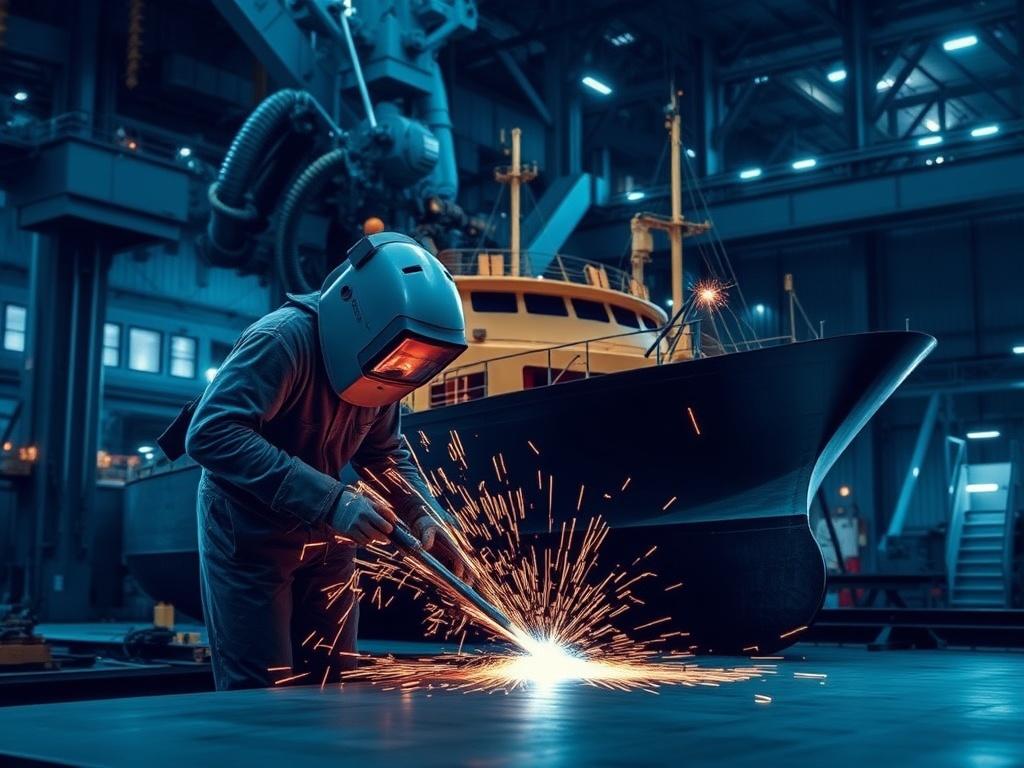
The maritime industry is constantly evolving, embracing new technologies to boost efficiency, reduce costs, and improve quality. The integration of automation and digitalization has revolutionized shipbuilding and marine welding techniques.
Robotics and Automation
Robotic welding systems increasingly automate routine and repetitive welds, especially for hull assembly. Robots enhance precision, consistency, and speed—decreasing human error and exposure to hazardous work environments.
Automated welding can include:
- Submerged Arc Welding robots for long, straight welds
- Laser welding for precise and narrow weld beads
- Automated welding stations controlled via CNC programming
Advanced Materials and Joining Techniques
Development in advanced materials, including high-strength steels and new alloys, demands adaptable welding practices. Additionally, innovations in friction stir welding and hybrid welding techniques are gaining ground in marine applications due to their ability to produce defect-free joints.
Virtual Reality and Simulation Training
Training marine welders now often incorporates virtual reality simulators that mimic complex welding scenarios in shipyards, providing risk-free, immersive learning environments. This fosters skill development before working on actual ships.
Conclusion: The Art and Science of Shipbuilding and Marine Welding
Shipbuilding and marine welding techniques stand at the intersection of tradition, engineering, and technology. Building a ship is not just an industrial task but a precise art form requiring deep knowledge of materials, methods, and environmental challenges. Marine welders and shipbuilders collaborate closely, ensuring that each vessel is strong, seaworthy, and ready to face the immense forces of nature.
Whether it’s the detailed craft of underwater welding or the automated efficiency of robotic welders, the field continues to evolve rapidly. As shipbuilding embraces newer models, greener technologies, and smarter materials, marine welding techniques will remain at the heart of the industry—building the ships that keep global trade moving and connecting the world.
If you’re fascinated by ships or considering a career in marine construction or welding, exploring these expansive techniques can open up a world of opportunity on the vast and intriguing oceans.